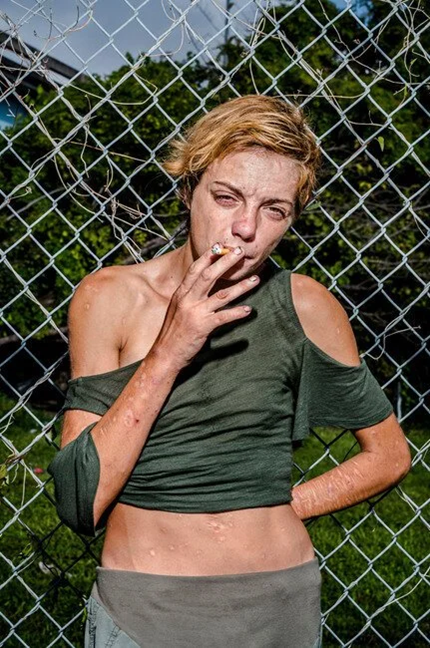
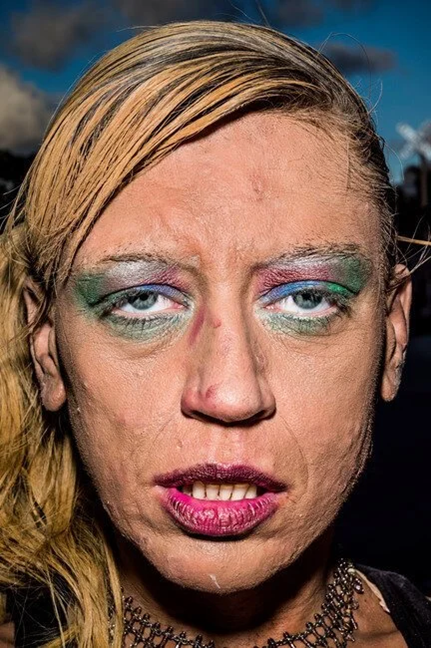
In the contemporary world of portrait photography, few figures divide audiences as sharply as Bruce Gilden. His images do not merely suggest they confront. Gilden’s signature close-up style mercilessly reveals every scar, tremor, and pore, compelling viewers to confront the raw, uncomfortable edge of human existence. However, his latest ambitious body of work, “Only God Can Judge Me,” goes beyond simple documentation; it becomes a powerful mirror reflecting the photographer’s own journey through pain and self-forgiveness.
For many years, Gilden was the quintessential, fearless street observer, defined by his harsh flash and unnerving proximity. Yet, during the creation of this project, which focuses on marginalized women in Miami’s Overtown district, a profound transformation occurred. His lens turned inward, away from mere defiance and towards the difficult processes of memory, guilt, and reconciliation.

The Echoes of a Hidden Past
When Gilden first arrived in Overtown around 2013, he was immediately drawn to the neighborhood’s complex mix of decay and stubborn resilience. What resonated most wasn’t the evident poverty, but the emotional depth etched onto the faces of the women whose lives were intertwined with addiction and sheer survival.
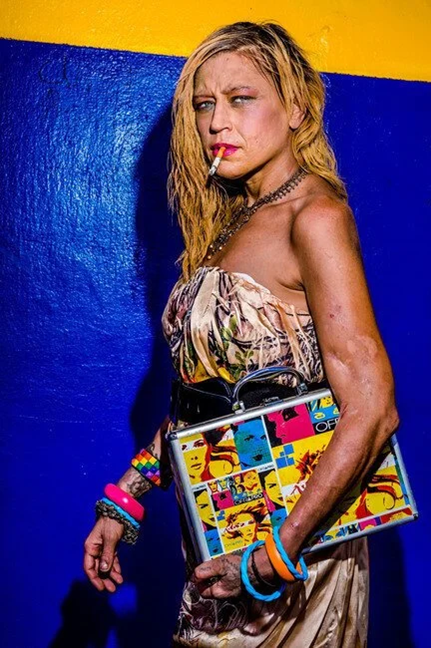
A central figure quickly emerged: Texas, whose magnetic presence disarmed the veteran photographer. She exuded a fierce confidence, flawless lipstick, a cigarette poised perfectly at once proud, bold, and fragile. Gilden famously described her appearance: she looked “like a model out of a dream until you notice the marks on her arm.”
This unusual bond transcended the typical photographer-subject relationship. Texas reminded Gilden of his mother, Pauline. Beneath the façade of a perfect 1950s Brooklyn homemaker, Pauline had fought a crippling, private battle with addiction to prescription drugs. When Gilden confided this past to Texas, her reply struck him deeply: “I’ll stop when it stops making me feel good.” Soon after, Texas succumbed to an overdose another devastating loss, another painful echo of his mother’s fate.
Confronting the Family Silence
To fully appreciate Only God Can Judge Me, one must understand the heavy silence that defined Gilden’s early life. Born in 1946, he grew up under the emotional shadow of his father, Daniel, whom he described as a “mafioso-type figure”—a man of rigid silence and emotional distance. The atmosphere in the house demanded secrecy and forbade talking about Pauline’s quiet breakdowns.
This childhood steeped in fear, confusion, and guilt shaped Gilden’s artistic sensibility long before he ever held a camera. When he began capturing people on the fringes of society, he wasn’t seeking out the bizarre; he was looking for familiarity. “What I photograph,” he later summarized, “is what I lived.” The blinding flash of his camera became his powerful tool for illuminating truths that were once forbidden to speak about.
Faces as Shared Confession
Years after her long struggle, Gilden’s mother was admitted to a psychiatric facility. He visited her once, taking a silent portrait the last he would ever make. Shortly following his father’s death, Pauline took her own life. Gilden’s guilt over not helping her “I didn’t do anything to help her. That’s when I really went off the end (with drugs)”plagued him for decades.
For him, art became a crucial form of refuge. In every deeply lined face he captured in Overtown, he saw fragments of Pauline. Photographing them wasn’t an act of exploitation; it was, for him, a necessary act of emotional reckoning. “In those women’s faces,” he realized, “I could finally see my mother’s story and maybe my own.”
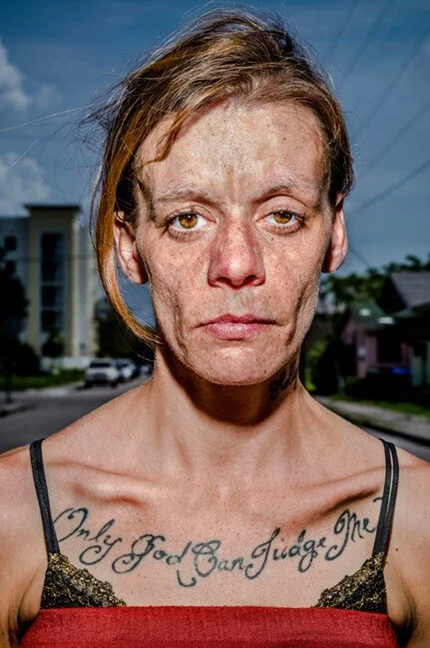
The project’s title, Only God Can Judge Me, originated from a tattoo worn by Jessica, a woman who became a vivid symbol of fierce survival. Her story, about growing up with family addiction, highlighted the core theme: the universal human struggle for dignity and forgiveness.
The Ethics of Vulnerability
Gilden’s close-up method has consistently ignited intense ethical debates. Critics have labeled his work “unforgivably invasive,” arguing his style turns human suffering into spectacle. Yet, Only God Can Judge Me recontextualizes this discussion. By publicly disclosing his own family trauma and emotional history, Gilden transformed the dynamic. His openness about his mother’s suicide and addiction shifts the relationship from observer to fellow participant.
Jonathan Ellery, who oversaw the publication of the book, noted that Gilden’s transparency about his mother’s fate “changes everything.” This is because the viewer’s gaze is no longer aimed at judging a stranger’s pain; it becomes a mirror reflecting a shared human fragility.
Photography as Redemption
Today, Gilden resides in Beacon, New York, far from the intensity of the streets where he earned his reputation. He often admits that the women of Overtown never truly left him, and the work continues to define his purpose.
“If someone can look at these photos,” Gilden stated, “and feel like they’re not alone in the world, then I’ve done my job.”
In this sense, Gilden’s art is not solely about documenting the broken; it is about restoring dignity. The women of Overtown are not passive victims of despair; they are vivid survivors, carrying their life experiences like visual poetry. Through them, Gilden finally confronted his own deeply buried history, finding a form of redemption in the process.
“Published Analysis based on Reports from The Guardian and Personal Interviews with Bruce Gilden”