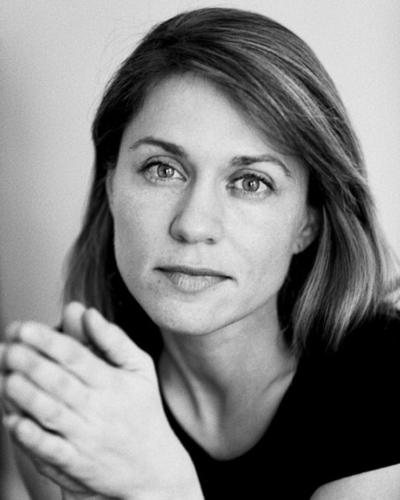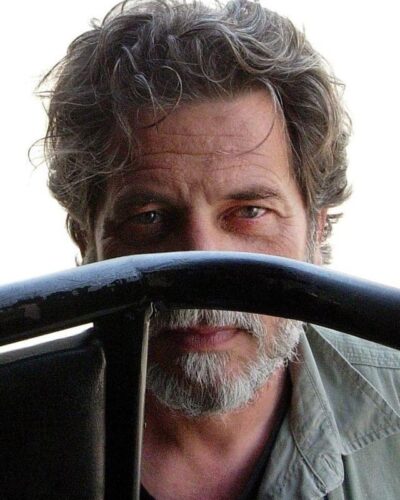
Black and white photography has a way of slowing down the world. Without color to distract, the viewer falls straight into the emotional core of an image the tension, the fragility, the humanity. Throughout the past century, countless photographers have embraced this stripped-down visual language, but a handful have shaped it so deeply that their influence still touches every street photography, portraitist, and documentary photographer today.
Whether you’re a photographer looking for inspiration or simply someone who loves visual storytelling, this list of the best black and white photographers you should know is a doorway into the history of monochrome art told through people who lived intensely and photographed even more intensely.
- Ansel Adams
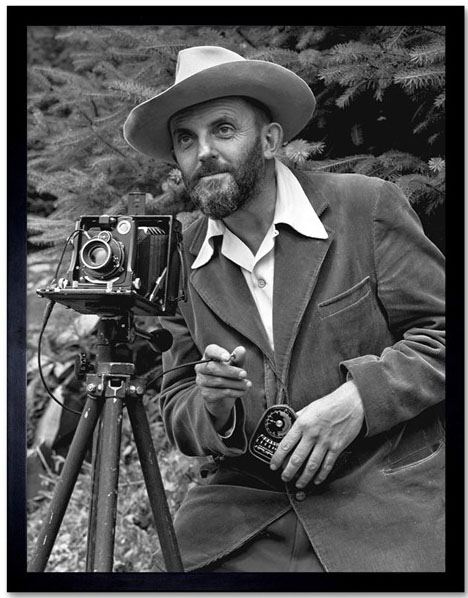
Few names are as synonymous with black and white photography as Ansel Adams. Born in San Francisco in 1902, Adams grew up with a profound love of nature a love that became the foundation of his life’s work. A self-taught pianist turned photographer, Adams used his camera to advocate for the preservation of the American wilderness, especially the rugged beauty of Yosemite Valley.
One of his most iconic photographs, “Moonrise, Hernandez, New Mexico” (1941), perfectly encapsulates his technical precision and emotional reach. In this image, the moon rises silently above a small New Mexican village, its white glow illuminating crosses in a cemetery while storm clouds retreat in the distance. Adams captured the shot under immense time pressure, calculating exposure on the spot. The result became one of the most printed and sought-after images in photographic history. What makes it so powerful is the harmony almost a spiritual dialogue between land and sky, life and death, darkness and light.
Adams mastered the Zone System, a technique he co-developed to help photographers control exposure and contrast with perfection. His tireless dedication to detail made his work both technically flawless and emotionally sweeping.
- Sally Mann
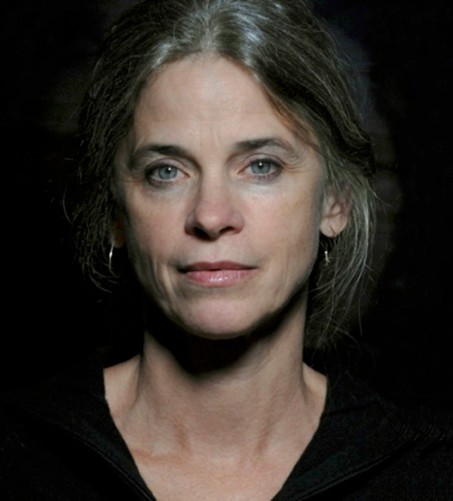
Born in Lexington, Virginia in 1951, Sally Mann is one of the most fearless photographers in modern American art. Her work blends the intimate with the universal, using family, landscape, and the passage of time as recurring themes. Mann’s photographs feel like fragments of memory soft, haunting, imperfect in the most deliberate of ways.
One of her defining images is “Candy Cigarette” (1989) from her series Immediate Family. The photograph shows her young daughter Jessie holding a cigarette with a pose so adult it startles the viewer. It’s a moment thick with contradiction: innocence performing adulthood, childhood brushing against rebellion. The scene wasn’t stagged, but Mann recognized immediately that it revealed the complex performance of identity that children slip into naturally. What makes her black and white work so impactful is her embrace of imperfections blur, grain, long exposures techniques that mimic the way memory erodes while emotion stays sharp.
Mann’s later work, particularly her series What Remains, focuses on mortality and decay, exploring dead landscapes, battlefields, and eventually her husband’s illness. Her gift lies in the way she transforms sorrow and ambiguity into beauty.
- Sebastião Salgado
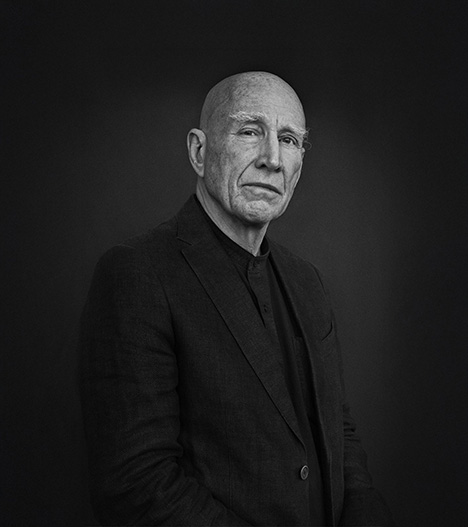
Brazilian photographer Sebastião Salgado, born in 1944, has devoted his life to documenting humanity’s most difficult stories migration, labor, famine, environmental destruction, and resilience. Trained as an economist, he abandoned that path in the 1970s to follow photojournalism full-time. His images carry a monumental weight, yet they never lose sight of human dignity.
One of his most powerful photographs appears in his series “Workers” (1986): men climbing a ladder inside the Serra Pelada gold mine in Brazil. Their bodies glisten with sweat and mud as they ascend the steep walls of the pit like a living pattern of struggle. The image feels biblical an entire nation of workers rising from the earth, swallowed by dust but fueled by hope. Salgado’s black and white style intensifies the drama, stripping the scene to shape and contrast while highlighting the scale of the hardship.
In recent years, Salgado turned to environmental activism with “Genesis,” a project that captures untouched corners of the planet. Even in the absence of human subjects, his photographs pulse with life.
- Don McCullin
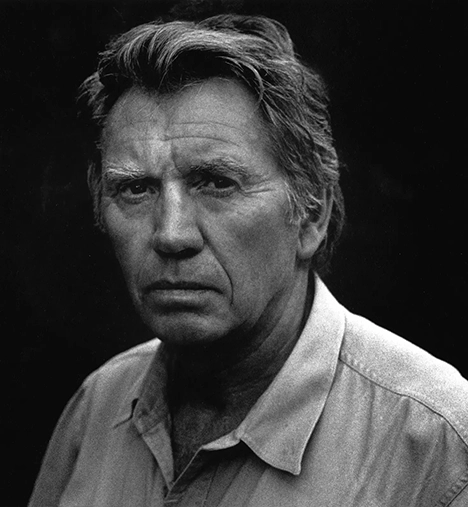
Born in London in 1935, Don McCullin is one of the most important war photographers of the 20th century. His career began almost accidentally when a local gang allowed him to photograph them, leading to his first published image in The Observer. From there, he traveled to conflict zones across Cyprus, Vietnam, Cambodia, Lebanon, and Biafra.
One of his most devastating images is “Shell-shocked US Marine, Hue, Vietnam (1968)”. The photograph shows a young American soldier staring blankly into the distance, his eyes hollow from exhaustion and trauma. There is no action, no explosion—just the quiet horror of a man who has seen too much. McCullin’s commitment to honesty in his work means he never romantticizes conflict; he reveals the cost.
Later in life, McCullin turned to rural landscapes in Somerset as a way to heal from decades of witnessing human suffering. Even these quieter images hold a solemnity that reflects the emotional weight he carries.
- Henri Cartier-Bresson
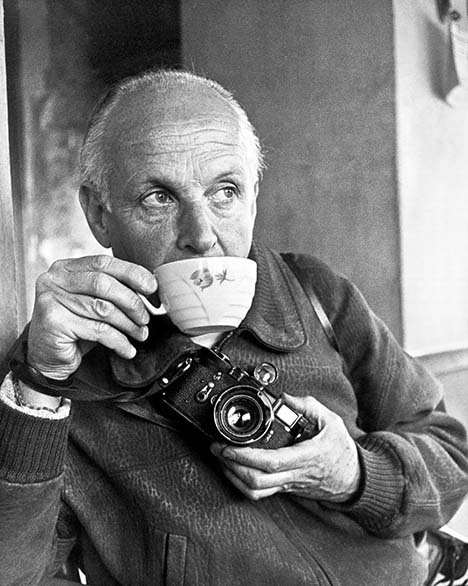
Often called the father of modern street photography, Henri Cartier-Bresson was born in France in 1908. He believed photography was the art of capturing the perfect moment “the decisive moment” when composition, emotion, and movement aligned effortlessly. Cartier-Bresson traveled extensively, documenting life across Europe, Asia, the Soviet Union, and the United States with a small Leica camera that allowed him to move quietly and intuitively.
A classic example of his philosophy is “Behind the Gare Saint-Lazare” (1932). The photograph shows a man leaping over a puddle, his silhouette frozen mid-air just before touching the water. What makes the image extraordinary is the harmony of elements: the reflection below, the shape of the fence, the murals in the background. Cartier-Bresson captured the shot through a hole in a fence without looking through the viewfinder—trusting instinct, timing, and a deep understanding of visual rhythm.
His influence on documentary and street photography is immeasurable, inspiring generations to chase authenticity rather than perfection.
- Mary Ellen Mark
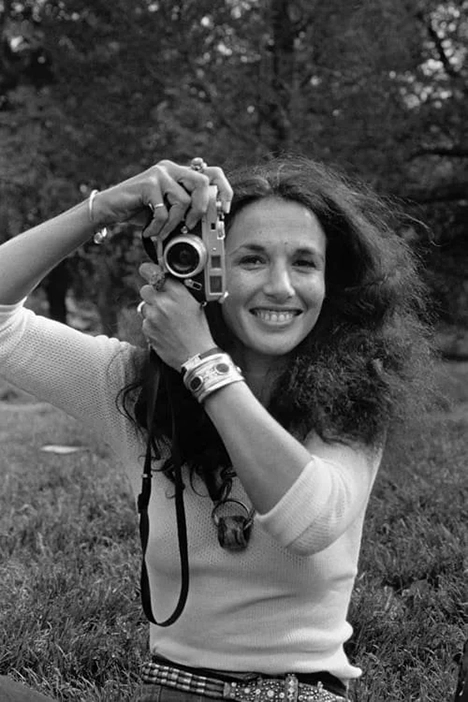
Born in Philadelphia in 1940, Mary Ellen Mark was a compassionate storyteller who photographed people living on society’s margins. Her work spans mental institutions, brothels, circuses, street children, and the overlooked lives most people avoid confronting. Yet her photographs are never exploitative they are collaborations built on trust.
One of her most haunting images is “Amanda and Her Cousin Amy, Valdese, North Carolina (1990)”. The photograph shows two young girls, one holding a cigarette, posing with a maturity that feels unsettling. Mark had a rare ability to capture the blurred lines between childhood and adulthood in American life, revealing uncomfortable truths about poverty, vulnerability, and identity.
Throughout her career, Mark produced long-term documentary projects, often returning to the same subjects over many years. Her empathy shaped her art, turning photographs into conversations rather than observations.
- Herbert List
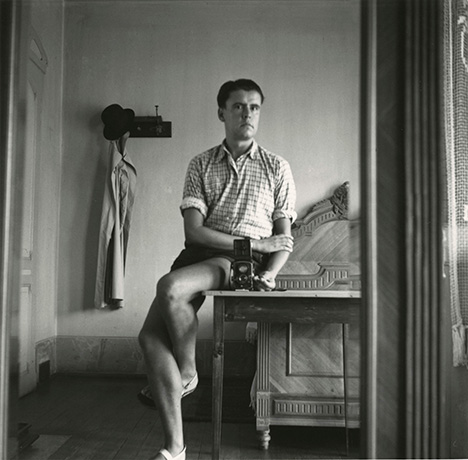
German photographer Herbert List was born in 1903 in Hamburg. Initially trained as a classicist, he immersed himself in art, literature, and philosophy interests that shaped the poetic surrealism of his photography. List’s black and white work is dreamy, symbolic, and composed with the precision of a sculptor. Many of his images feel like scenes from a myth or a half-remembered dream.
One of his best-known photographs is “The Sailor, Italy (1935)”, part of his early surrealist period. The image shows a young man reclining on a boat, his face turned away as sunlight casts geometric shadows across his body. The composition flirts with abstraction, turning the human form into a mixture of light, line, and gesture. List was deeply influenced by the aesthetic of classical sculpture, and it shows in the calm, statuesque pose of his subjects.
Later in life, List joined Magnum Photos and captured portraits of artists such as Picasso and Cocteau. Despite his influence, his work remained underappreciated until decades after his death in 1975.
- Dorothea Lange
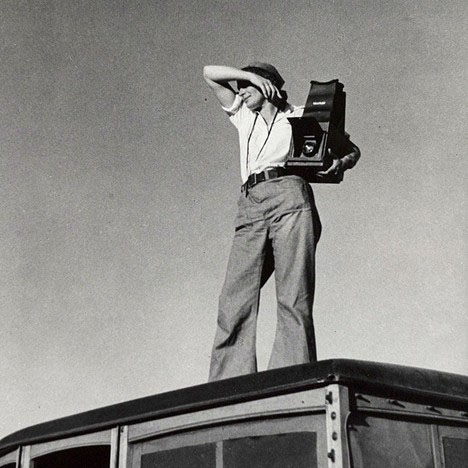
Born in Hoboken, New Jersey in 1895, Dorothea Lange began her career as a portrait photographer before joining the Farm Security Administration during the Great Depression. Her mission was to document the strugles of displaced farmers, migrant workers, and families living in poverty. Lange’s deep empathy helped her create some of the most iconic American photographs of the 20th century.
Her most famous image, “Migrant Mother” (1936), shows Florence Owens Thompson surrounded by her children, her face tense with worry and determination. Lange met the family by chance near a pea-picker camp in Callifornia. The photograph became a symbol of the resilience and suffering of the era. The soft light, the children’s turned heads, and the mother’s furrowed brow all work together to tell a story of fear mixed with unbreakable strength.
Lange believed that photography could change public awareness, and her work helped shape U.S. policies toward migrant labor. Today, her images remain not just historical documents but emotional mirrors reflecting human endurance.
- Daido Moriyama
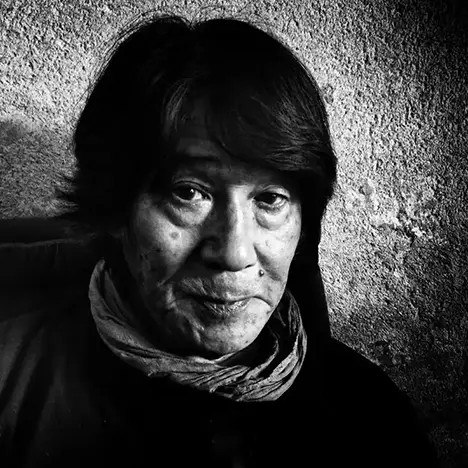
Born in Osaka in 1938, Daido Moriyama is one of the most influential Japanese photographers of the post-war era. His images are gritty, chaotic, and intentionally imperfect. Moriyama embraced blur, grain, harsh contrast, and unconventinal framing to create a raw, emotional language that matched the restless spirit of urban Japan.
One of his defining works is “Stray Dog, Misawa (1971)”. The photograph shows a black dog standing in a street, staring directly into the camera with a mixture of tension and defiance. The dog becomes a metaphor for Moriyama himself wandering, observant, untamed. The high contrast and tight cropping give the image a cinematic unease that pulls the viewer into the dog’s world.
Moriyama’s approach was influenced by Jack Kerouac, Andy Warhol, and the Provoke movement. His photographs feel like fragments of a diary fast, emotional, intuitive, and unapologetically imperfect.
- Elliott Erwitt
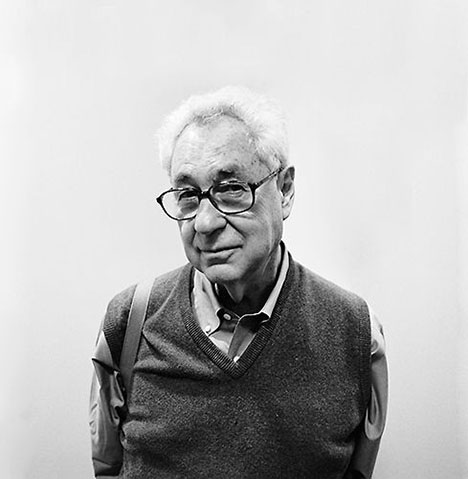
Born in Paris in 1928 and raised in the United States, Elliott Erwitt became a master at capturing humor and tenderness in everyday life. A longtime member of Magnum Photos, Erwitt spent decades documenting dogs, lovers, families, and fleeting moments that reveal how wonderfully absurd human existence can be.
One of his most beloved images is “Dog’s Eye View, New York City (1946)”. In this whimsical photograph, a tiny Chihuahua sits next to a pair of towering human legs and a Great Dane. Erwitt shot the image from street level, turning an ordinary sidewalk scene into an endearing visual joke. His genius lies in his timing and ability to find poetry and comedy in the mundane.
Erwitt photographed presidents, celebrities, and historic events, yet his personal work especially his dog series remains the purest expression of his personality: warm, witty, observant, and endlessly curious.
Final Thoughts
Black and white photography is more than a stylistic choice it’s a way of seeing. These ten photographers transformed monochrome into a language capable of expressing grief, hope, humor, conflict, beauty, and the deepest layers of humanity.
Whether you’re drawn to the stillness of Ansel Adams, the rawness of Daido Moriyama, or the empathy of Dorothea Lange, each artist on this list offers a lifetime of inspiration. Their photographs remind us that when the distractions fall away and only light and shadow remain, the truth becomes impossible to ignore.