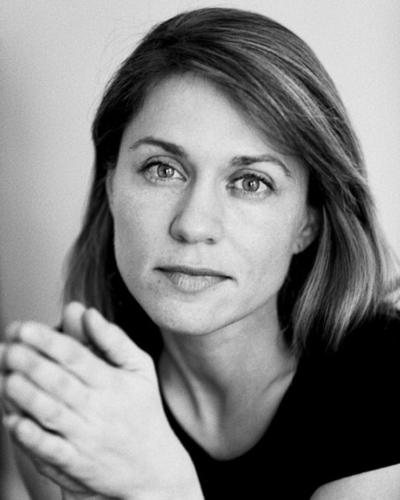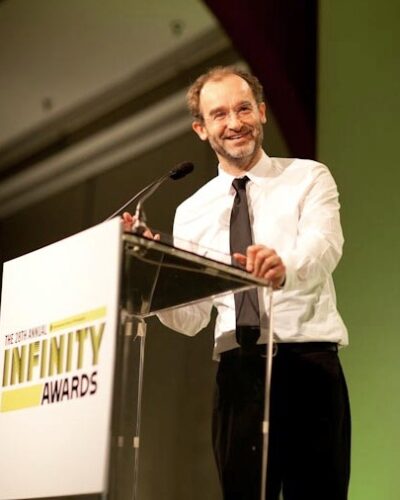
Street photography is a genre that captures the essence of everyday life, often in urban settings, revealing the beauty, humor, and sometimes the harsh realities of the human condition. In England, street photography has a rich history, with photographers documenting the changing social landscape from the post-war era to the present day. This article explores the best street photographers in the history of England, whose work has not only defined the genre but also provided a unique window into English life and culture.
These street photographers have used their lenses to capture moments that are fleeting yet timeless, creating images that resonate with viewers across the globe. From the satirical eye of Martin Parr to the compassionate gaze of Shirley Baker, each brings a distinct perspective to the streets of England. Below, we delve into their lives, their photographic techniques, their contributions to the art of street photography, and a famous quote that encapsulates their philosophy.
Martin Parr
Born in 1952 in Epsom, Surrey, Martin Parr is a globally celebrated street photographer whose vibrant, satirical images redefine the genre. His work explores consumerism, leisure, and British identity with bold colors and sharp social commentary. Starting in the 1970s with black-and-white photography, Parr transitioned to color, which became his signature. His breakthrough series, The Last Resort (1986), captured working-class holidaymakers in New Brighton, sparking debate with its unflinching honesty. A member of Magnum Photos since 1994, Parr has published photobooks like Think of England (2000), curated exhibitions, and mentored emerging street photographers. His global exhibitions highlight his enduring influence, as he continues to challenge perceptions of everyday life.
Parr’s photographic style is characterized by its use of intense flash and close proximity to subjects, creating stark, hyper-real images. His vibrant color palette amplifies the garishness of consumer culture, turning mundane scenes—like seaside ice cream stands or cluttered tea rooms—into satirical spectacles. By framing scenes tightly, Parr captures intimate details, from garish clothing to awkward gestures, revealing societal absurdities with humor and irony. His compositions often feel chaotic yet deliberate, drawing viewers into the contradictions of modern life.
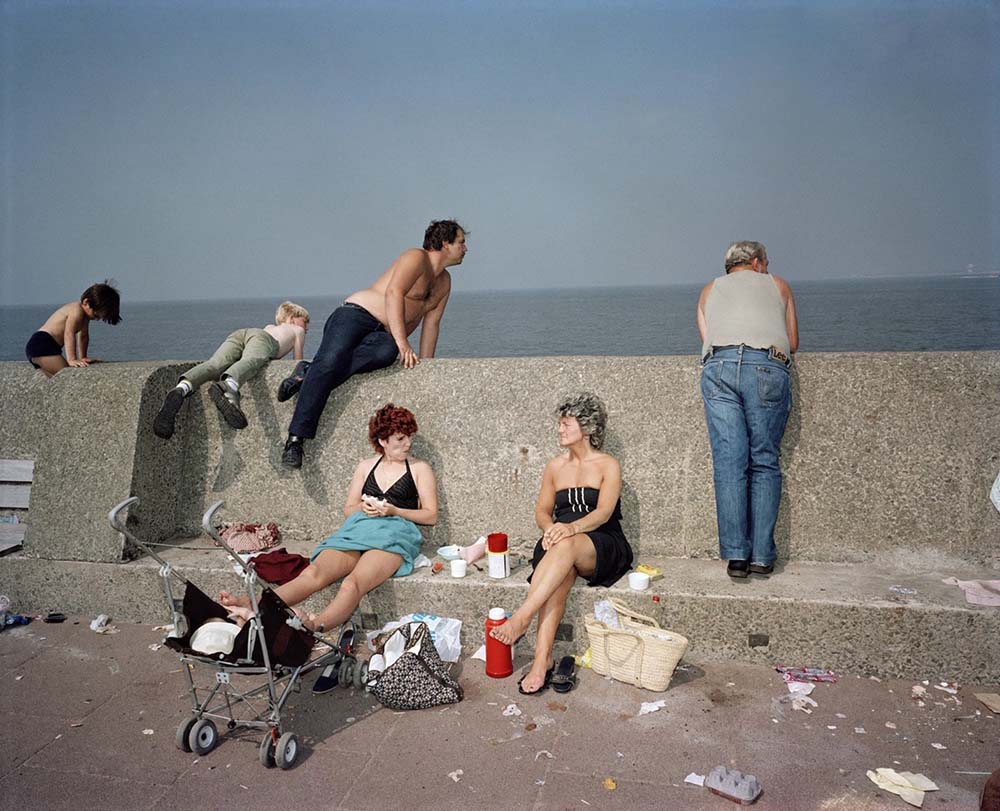
His approach transforms the ordinary into the extraordinary, using visual exaggeration to critique social norms. For example, in The Last Resort, Parr’s images of sunburned tourists amidst litter-strewn beaches highlight the tension between leisure and economic struggle. His ability to blend documentary with commentary makes his work a cornerstone of street photography, inviting viewers to question the world around them.
Quote: “Photography is the simplest thing in the world, but it is incredibly complicated to make it really work.”
Tony Ray-Jones
Born in 1941 in Wells, Somerset, Tony Ray-Jones was a trailblazer whose brief career left a lasting impact on street photography. Influenced by American photographers like Garry Winogrand while studying in London, he returned to England in the 1960s to document its leisure culture. His series A Day Off (1974), published posthumously after his death from leukemia at 30, captures English traditions with wit and complex compositions. Ray-Jones’s influence on photographers like Martin Parr underscores his legacy as a pioneer who showed street photography could be both artistic and documentary.
Ray-Jones’s technique relied on meticulous observation and layered compositions. He often used a wide-angle lens to capture multiple elements within a single frame, creating narrative depth. His images of seaside resorts or public festivals juxtapose quirky characters—like a man in a top hat next to a child with a balloon—with subtle social commentary. His black-and-white photography emphasizes texture and contrast, lending a timeless quality to scenes of 1960s England. Ray-Jones’s ability to find humor in the mundane, such as a dog show or a rainy beach outing, reveals his keen eye for cultural idiosyncrasies.
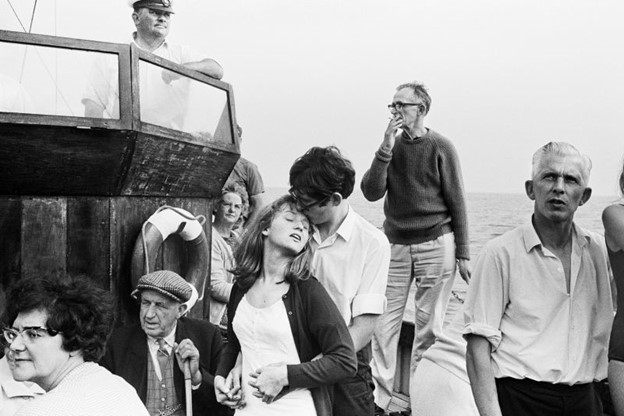
His guiding principle, “observe, think, and create,” is evident in his deliberate framing, where every element serves the story. Ray-Jones avoided staged shots, instead waiting for candid moments that unfold naturally. His photographs, like those in A Day Off, are not mere snapshots but carefully constructed tableaux that invite viewers to uncover deeper truths about English society, making his work a touchstone for street photographers.
Quote: “Photography can be a powerful medium, a way of saying something about the world.”
Chris Killip
Born in 1946 in Douglas, Isle of Man, Chris Killip’s empathetic street photography documented England’s working-class communities, particularly in the North. His seminal work, In Flagrante (1988), portrays the industrial Northeast during the Thatcher era, capturing resilience amid economic decline. Living in Newcastle in the 1970s, Killip immersed himself in his subjects’ lives, earning trust to create stark yet humane images. Works like Seacoal and Pirelli Work reflect his commitment to social documentary. Exhibited internationally, Killip’s photographs combine artistry with social critique, cementing his status as a key figure in street photography.
Killip’s photographic style is defined by its raw, monochromatic intensity. Using medium-format cameras, he captured high-contrast images that emphasize the textures of industrial landscapes and weathered faces. His compositions often place subjects against stark backdrops, like crumbling factories or barren beaches, highlighting their dignity amidst hardship. In In Flagrante, a portrait of a coal scavenger staring directly at the camera conveys both defiance and vulnerability, a testament to Killip’s ability to evoke emotion through minimalism. His long-term engagement with communities ensured authenticity, avoiding voyeurism.
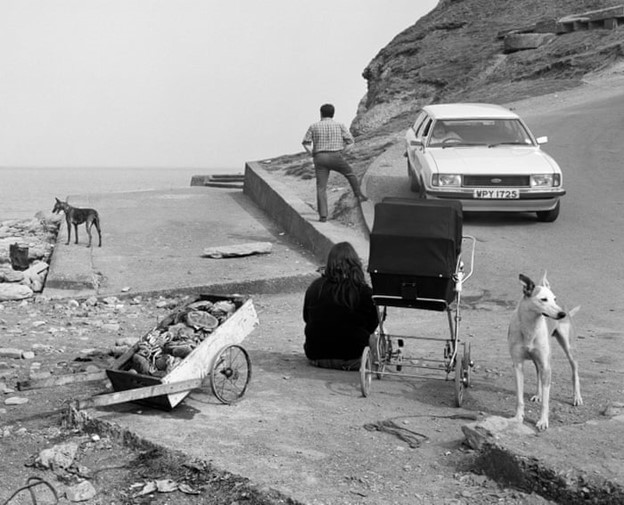
His approach prioritizes context, with each image telling a broader story of deindustrialization. Killip’s use of natural light and wide apertures creates a sense of immediacy, as if viewers are witnessing the scene firsthand. His photographs are not just visual but visceral, conveying the weight of economic and social change. This fusion of documentary and emotional depth makes Killip’s work a powerful contribution to street photography, resonating with audiences globally.
Quote: “You don’t just go out and make photographs. You have to live with the people to understand them.”
Shirley Baker
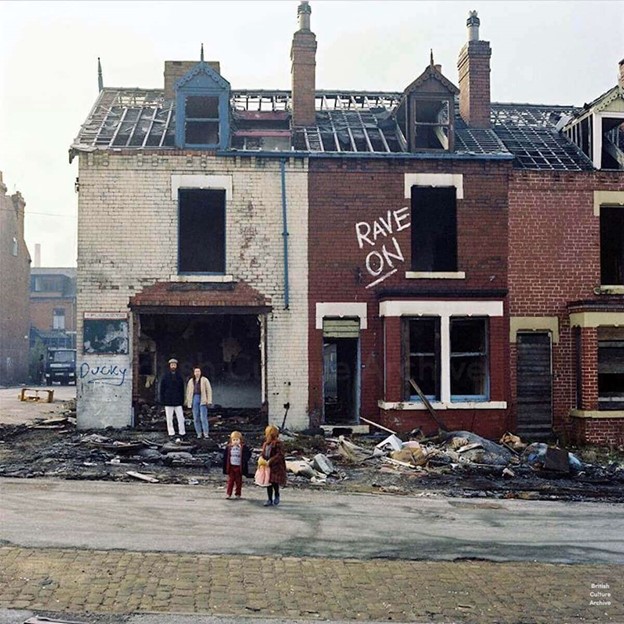
Born in 1932 in Salford, Greater Manchester, Shirley Baker was a pioneering female street photographer who captured Manchester and Salford’s working-class communities during the 1960s and 1970s. Her series Street Photographs: Manchester and Salford documents urban life amidst slum clearances, focusing on children, mothers, and elderly residents. Starting with newspaper work in the 1950s, Baker pursued personal projects, becoming one of few photographers documenting Northern England’s streets. Her warm, humane images, often overlooked during her lifetime, gained posthumous recognition for their artistic and historical value, making her a vital figure in street photography.
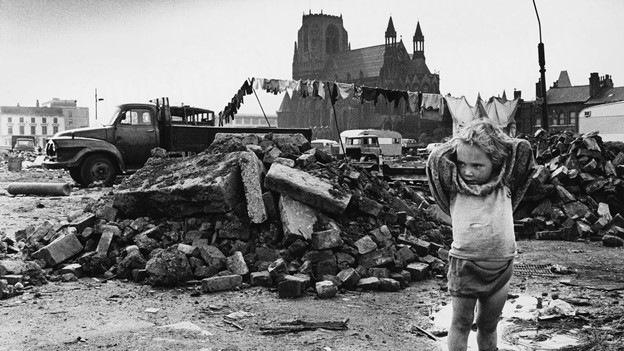
Baker’s photographic style is marked by its warmth and spontaneity, often using a 35mm camera to capture fleeting moments. Her black-and-white images emphasize the vibrancy of community life, with children playing hopscotch or neighbors chatting on doorsteps set against crumbling terraces. Baker’s compositions are loose yet intentional, creating a sense of intimacy that invites viewers into her subjects’ world. Her use of soft lighting and shallow depth of field draws attention to human interactions, highlighting resilience amid poverty. For instance, an image of children laughing in a rubble-strewn street captures joy in adversity.
Her approach avoided sensationalism, focusing instead on the dignity of everyday life. Baker’s ability to blend documentary with emotional nuance allowed her to create images that are both nostalgic and socially incisive. Her photographs serve as a historical record of urban transformation, preserving the spirit of communities lost to redevelopment. This empathetic lens makes Baker’s work a cornerstone of street photography, celebrating the humanity of England’s working-class neighborhoods.
Quote: “I never set out to shock, only to observe and record what I saw.”
David Hurn
Born in 1934 in Redhill, Surrey, David Hurn, a Magnum Photos member, is renowned for his street photography capturing everyday life in England and Wales. Starting in the 1950s, he covered events like the Hungarian Revolution, but his street work focuses on intimate moments. Since the 1970s, his photographs of Wales, where he resides, reflect its landscapes and culture with clarity. As founder of the School of Documentary Photography in Newport, Hurn has mentored countless street photographers. His work’s simplicity and authenticity highlight the genre’s storytelling power.
Hurn’s photographic style emphasizes clarity and directness, often using a 35mm camera with standard lenses to maintain a natural perspective. His black-and-white images capture candid moments—like a couple strolling in a Welsh village or children playing in a field—with precise framing that feels unintrusive. Hurn’s compositions are clean, often isolating subjects to emphasize their actions or expressions, creating a sense of universality. His use of natural light enhances the authenticity of scenes, making them timeless reflections of human behavior.
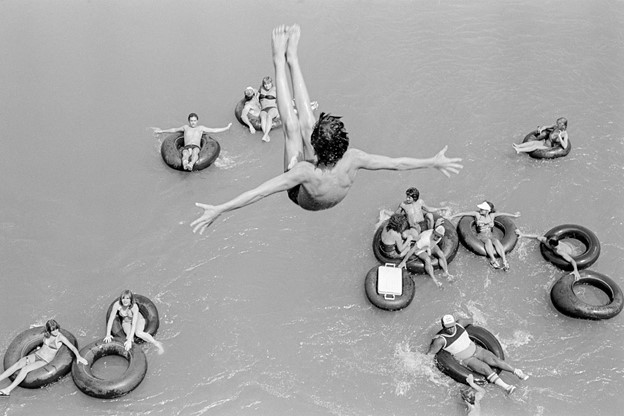
His approach prioritizes being present and observant, allowing moments to unfold organically. Hurn’s images, such as those documenting Welsh traditions, reveal the extraordinary in the ordinary, from a farmer herding sheep to a local fair. His ability to distill complex scenes into simple, evocative frames underscores his mastery of street photography. By mentoring others, Hurn has extended his influence, ensuring the genre’s continued evolution while remaining a touchstone for capturing life’s quiet beauty.
Quote: “Life as it unfolds in front of the camera is full of so much complexity, wonder, and surprise.”
Daniel Meadows
Born in 1952 in Great Washbourne, Gloucestershire, Daniel Meadows’s collaborative street photography documents ordinary English lives. His Free Photographic Omnibus project in the 1970s involved traveling in a bus-turned-studio, offering free portraits to communities. This participatory approach created an intimate archive of English life, emphasizing the photographer-subject relationship. Meadows’s work, including oral histories and digital storytelling, challenges traditional notions of authorship. His respectful, engaging images give voice to the overlooked, making him a pioneer in street photography.
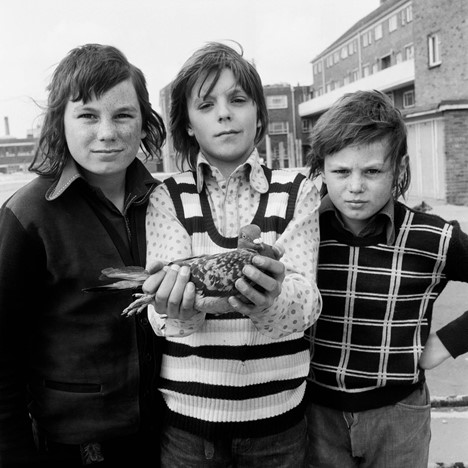
Meadows’s photographic style is intimate and unpretentious, using a 35mm camera to capture portraits and candid scenes. His black-and-white images from the Omnibus project feature subjects like shopkeepers, children, or pensioners, often posed naturally in their environments. Meadows’s compositions are straightforward, focusing on facial expressions and body language to convey personality. His use of soft lighting and medium apertures creates a gentle depth, drawing viewers into the lives of his subjects. For example, a portrait of a market trader smiling proudly beside his stall exudes warmth and authenticity.
Cropping was out–he told us to shoot full-frame so the “quality of the visual problem is improved.” Winogrand told us to photograph what we linked, and to trust our choices, even if nobody else agreed with them.”
Although cropping can be a great tool to improve your photographs, it can also be another crutch. I used to crop quite a bit for my street photographs (when I had a messy background or distracting elements). However this lead me to having the mentality of not getting the photo right “in-camera” as I would subconsciously think to myself: “If the framing isn’t good, I can always crop later”.
Once again, try to get your framing right in-camera- as it will force you to “dance around” more on the streets to get a more coherent shot. Instead of shooting people against distracting backgrounds, it will encourage you to walk around them, taking a photograph of them behind a more simple background (that is less distracting). We will also get closer to our subjects to frame them better, rather than just cropping in from around the frame.
I am not saying that you should never crop a photograph (if you look at Robert Frank’s contact sheets of “The Americans” – he cropped a lot of his photographs), but try to do it in moderation and sparingly.
Homer Sykes
Born in 1949 in Vancouver, Canada, but raised in London, England, Homer Sykes blends street photography and documentary to capture British customs. His book Once a Year: Some Traditional British Customs (1977) documents quirky festivals like the Burry Man parade with humor and insight. Starting in the 1960s, Sykes photographed music scenes, protests, and urban life, always seeking the decisive moment. His extensive archive offers a rich visual history of England, celebrating its eccentricities and resilience.
Sykes’s photographic style is dynamic and immersive, often using a 35mm camera to capture the energy of public events. His black-and-white images, like those in Once a Year, feature crowded scenes of costumed participants or cheering crowds, framed to convey atmosphere. Sykes’s use of high-contrast lighting and fast shutter speeds freezes action, highlighting details like a dancer’s expression or a spectator’s laughter. His compositions balance chaos and order, guiding viewers through complex scenes with visual clarity.
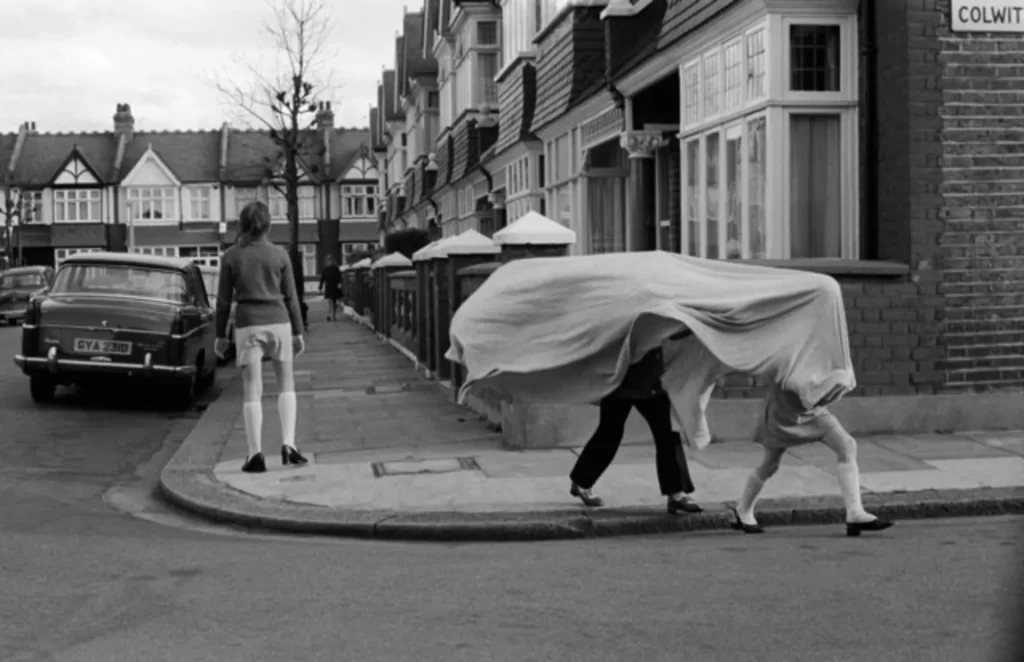
His approach focuses on capturing the spirit of traditions, blending candid observation with documentary precision. Sykes’s ability to find humor and humanity in events like cheese-rolling contests or May Day celebrations makes his work both entertaining and insightful. His photographs serve as a cultural archive, preserving England’s unique customs for future generations. This fusion of street photography’s spontaneity with documentary depth cements Sykes’s place in the genre’s history.
Quote: “I’m fascinated by the way people behave when they think no one is watching.”
Paul Graham
Born in 1956 in Beaconsfield, Buckinghamshire, Paul Graham’s 1980s work, like A1 – The Great North Road (1983), pioneered color in documentary street photography. His subtle style, seen in Beyond Caring (1985) and Troubled Land (1987), addresses social issues with nuance. Graham’s careful compositions and use of color convey mood and narrative, expanding the genre’s possibilities. His influence inspires street photographers to experiment with form and perspective.
Graham’s photographic style is understated yet evocative, using color film to capture the mood of 1980s England. His images in A1 – The Great North Road feature roadside diners, petrol stations, and travelers, framed with a wide-angle lens to emphasize context. Graham’s muted color palette—soft blues, greys, and browns—creates a melancholic atmosphere, reflecting economic stagnation. His compositions are deliberate, often placing subjects off-center to suggest transience or isolation, inviting viewers to ponder underlying narratives.
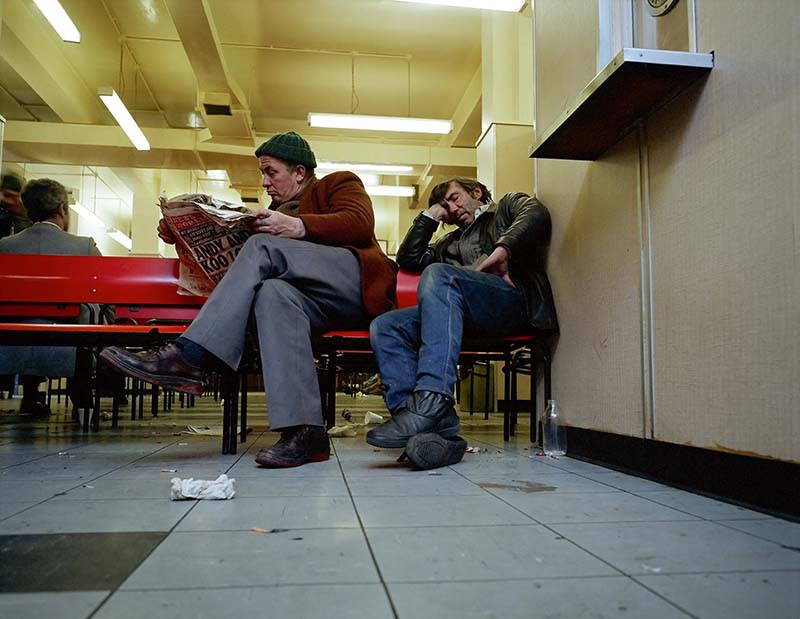
His approach challenges traditional black-and-white documentary norms, using color as a storytelling tool. In Beyond Caring, Graham’s images of crowded unemployment offices use harsh fluorescent lighting and tight framing to convey claustrophobia and despair. His ability to blend landscape, portraiture, and social commentary within a single frame makes his work innovative. Graham’s contributions have reshaped street photography, encouraging experimentation with color and form to reveal deeper societal truths.
Quote: “The world is far more complex than any photograph can ever show.”
Tish Murtha
Born in 1956 in South Shields, Tyne and Wear, Tish Murtha’s empathetic street photography documented Northeast England’s marginalized communities. Her series Youth Unemployment (1981) captures the human cost of economic hardship with humor and compassion. Despite personal challenges, Murtha’s images are acts of solidarity, giving voice to the silenced. Gaining posthumous recognition, her work is celebrated for its artistic and social impact, making her a key figure in street photography.
Murtha’s photographic style is raw and intimate, using a 35mm camera to capture candid moments of children and young people. Her black-and-white images in Youth Unemployment feature teenagers loitering on street corners or playing in abandoned lots, framed to highlight their resilience. Murtha’s use of high-contrast lighting and medium apertures creates sharp, emotional portraits that emphasize defiance or vulnerability. Her compositions often include environmental details—like graffiti-covered walls or derelict buildings—to contextualize her subjects’ lives.
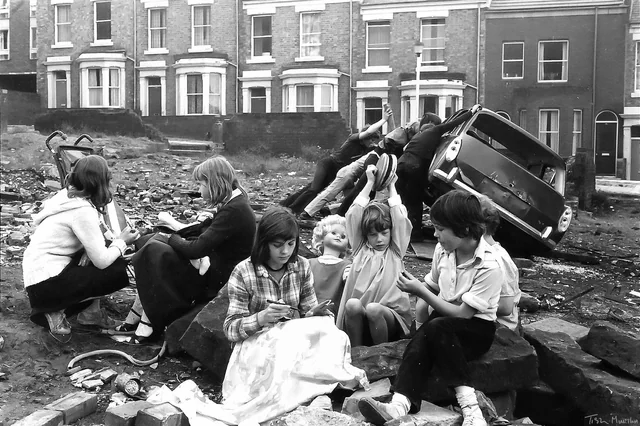
Her approach was deeply personal, reflecting her own working-class roots. Murtha’s images avoid pity, instead celebrating the creativity and spirit of her subjects, such as kids performing cartwheels amidst rubble. Her ability to combine social critique with humanity makes her work both politically charged and universally relatable. Murtha’s photographs are a vital record of 1980s England, contributing to street photography’s legacy of giving voice to the marginalized.
Quote: “Photography is about truth, about showing the world as it really is.”
Nick Turpin
Born in 1969 in London, Nick Turpin’s witty street photography captures urban life’s spontaneity. As founder of the iN-PUBLiC collective, he has promoted street photography globally through exhibitions and workshops. His clean compositions and use of light and shadow find beauty in the everyday, reflecting the genre’s candid tradition while embracing digital technology. Turpin’s advocacy ensures street photography’s continued relevance.
Turpin’s photographic style is sharp and playful, using a digital camera to capture fleeting urban moments. His color images often feature visual puns—like a man’s shadow aligning with a street sign—framed with precise timing. Turpin’s use of natural light and high shutter speeds freezes action, creating crisp compositions that highlight humor or irony. His images of London commuters or street performers balance spontaneity with careful geometry, drawing viewers into the city’s rhythm.
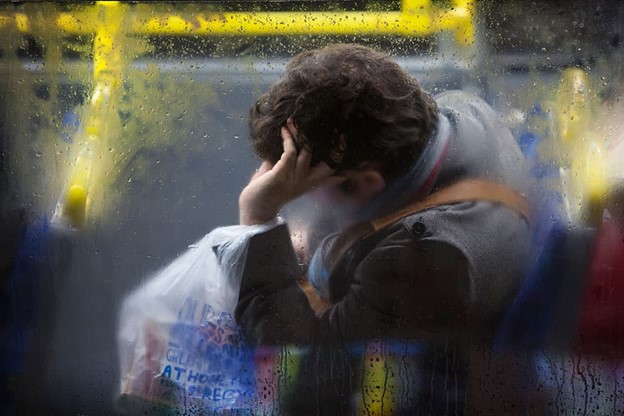
His approach embraces the unpredictability of street photography, seeking serendipitous moments that reveal human quirks. Turpin’s ability to find beauty in the mundane, such as reflections in puddles or odd juxtapositions, reflects his mastery of observation. His work with iN-PUBLiC has fostered a global community of street photographers, amplifying the genre’s reach. Turpin’s blend of traditional candid techniques with modern technology makes him a vital contemporary voice in street photography.
Quote: “Street photography is about seeing the extraordinary in the ordinary.”
Matt Stuart
Born in 1974 in London, Matt Stuart’s vibrant street photography captures surreal moments in London’s streets. His keen eye for juxtaposition and timing creates humorous, dynamic images. Stuart’s work, widely exhibited, reflects the chaos and charm of urban life, making him a leading contemporary street photographer.
Stuart’s photographic style is bold and spontaneous, using a 35mm camera to capture quirky urban scenes. His color images often feature absurd coincidences—like a pigeon seemingly directing traffic or a child mimicking a billboard pose—framed with split-second precision. Stuart’s use of bright lighting and fast apertures creates vivid, energetic compositions that pop with life. His ability to anticipate action allows him to capture fleeting moments that transform the ordinary into the surreal.
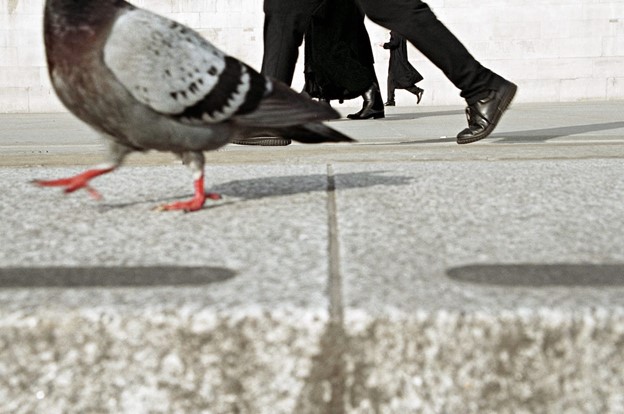
His approach relies on patience and quick reflexes, often spending hours waiting for the perfect alignment of elements. Stuart’s images, such as a man walking past a wall painted with a matching silhouette, showcase his knack for visual wit. His work celebrates London’s diversity and unpredictability, contributing to street photography’s tradition of finding magic in the everyday. Stuart’s global exhibitions and publications have solidified his status as a modern master of the genre.
Quote: “You have to be quick, but you also have to be patient.”
Don McCullin
Born in 1935 in London, Don McCullin, renowned for war photography, also produced powerful street photography. His 1960s and 1970s images of London’s homeless and industrial decline convey social hardship with stark intensity. McCullin’s emotional depth and commitment to truth make his street work a vital part of his legacy.
McCullin’s photographic style is gritty and unflinching, using a 35mm camera to capture raw human experiences. His black-and-white images of London’s East End feature homeless individuals or factory workers, framed against bleak urban landscapes. McCullin’s high-contrast lighting and deep depth of field create stark, textured compositions that emphasize suffering and resilience. For example, a portrait of a homeless man staring into the distance conveys profound sorrow, drawing viewers into his story.
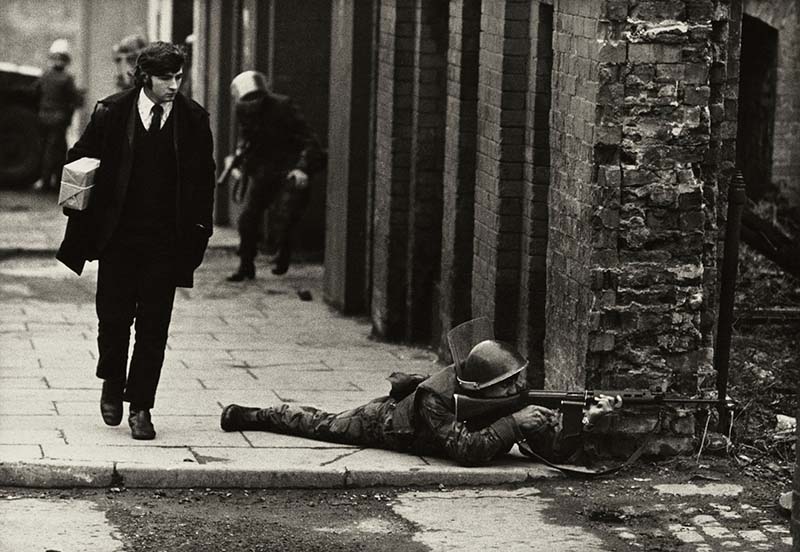
His approach is driven by empathy and moral urgency, seeking to expose social injustices. McCullin’s street photographs, like those of derelict neighborhoods, avoid sensationalism, instead offering a dignified portrayal of struggle. His ability to evoke emotion through minimalism makes his work a powerful contribution to street photography. McCullin’s images remain a haunting reminder of England’s social challenges, influencing photographers to use the medium as a tool for change.
Quote: “Photography for me is not looking, it’s feeling.”
Paul Russell
Born in 1966 in Weymouth, Dorset, Paul Russell’s street photography is filled with visual puns and humor. His candid images of English life highlight absurdities with a playful perspective, capturing the magic in everyday moments. Russell’s work adds a lighthearted dimension to street photography.
Russell’s photographic style is whimsical and spontaneous, using a digital camera to capture quirky street scenes. His color images often feature humorous coincidences—like a dog appearing to read a newspaper or a child’s balloon matching a street sign—framed with playful precision. Russell’s use of soft lighting and medium apertures creates vibrant, approachable compositions that invite laughter. His ability to spot fleeting moments of absurdity reflects his sharp observational skills.
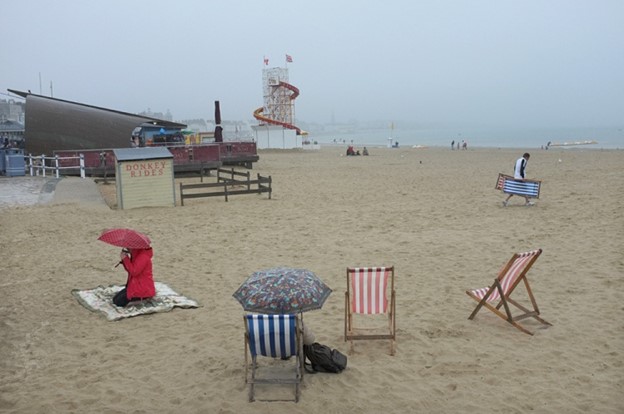
His approach celebrates the joy of discovery, seeking moments where reality feels slightly magical. Russell’s images, such as a man inadvertently mimicking a shop window mannequin, showcase his talent for transforming the mundane into delightful narratives. His work resonates with audiences for its accessibility and charm, contributing to street photography’s tradition of finding humor in the everyday. Russell’s growing recognition highlights his role in keeping the genre fresh and engaging.
Quote: “I’m always looking for the moment where reality becomes a little bit magical.”
Val Wilmer
Born in 1941 in Harrogate, North Yorkshire, Val Wilmer, a pioneering female street photographer, captured London’s multicultural communities in the 1960s and 1970s. Her authentic, respectful images, often tied to music and social movements, reflect the diversity of urban life. Wilmer’s work enriches street photography’s narrative.
Wilmer’s photographic style is intimate and unintrusive, using a 35mm camera to capture candid moments of community life. Her black-and-white images feature jazz musicians, Caribbean festivals, or market scenes, framed to highlight cultural vibrancy. Wilmer’s use of natural light and medium depth of field creates soft, textured compositions that feel authentic. For instance, an image of dancers at a Notting Hill Carnival captures movement and joy, reflecting her ability to convey atmosphere.
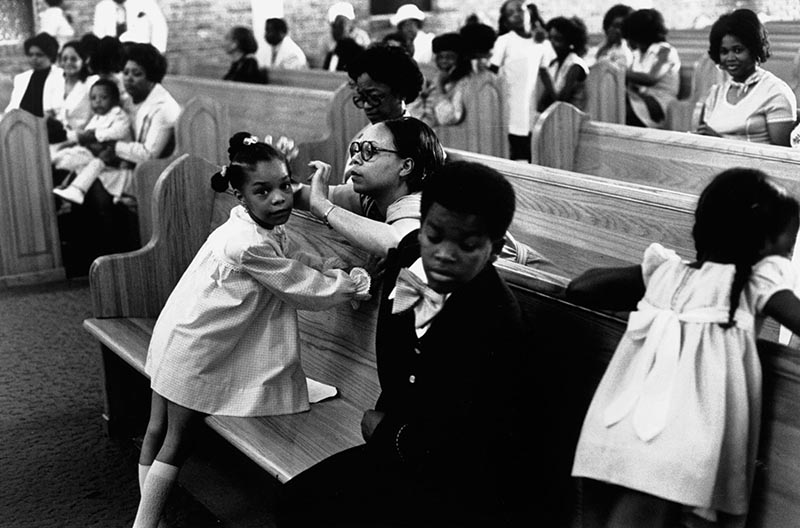
Her approach is rooted in respect and curiosity, building trust with subjects to create genuine portraits. Wilmer’s images avoid stereotypes, instead celebrating the diversity of London’s immigrant communities. Her work, blending street photography with documentary, preserves a vital record of cultural integration. Wilmer’s contributions have expanded the genre’s scope, inspiring photographers to document marginalized voices with sensitivity and authenticity.
Quote: “Photography is about capturing the soul of a moment.”
Peter Mitchell
Born in 1943 in Manchester, Peter Mitchell’s street photography documents Leeds with a surreal, humorous perspective. His series A New Refutation of the Viking 4 Space Mission (1979) blends social observation with artistic vision, creating a unique record of English life. Mitchell’s work challenges conventional street photography norms.
Mitchell’s photographic style is distinctive and theatrical, using a medium-format camera to capture Leeds’s urban landscapes and residents. His color images feature shopfronts, factories, or quirky characters, framed with a wide-angle lens to create a slightly surreal effect. Mitchell’s use of soft, even lighting and muted colors gives his photographs a dreamlike quality, as if viewing an alternate reality. For example, an image of a butcher’s shop with a cardboard astronaut cutout juxtaposes the mundane with the fantastical.
His approach blends documentary with fiction, using playful compositions to comment on urban change. Mitchell’s images, like those of Leeds’s disappearing small businesses, are both nostalgic and forward-looking, inviting viewers to question progress. His unique vision has made him a cult figure in street photography, influencing photographers to experiment with narrative and aesthetics. Mitchell’s work remains a vibrant celebration of England’s everyday eccentricities.
Quote: “Every photograph is a kind of fiction, but it’s also a kind of truth.”
Conclusion
The street photographers featured in this article have each made significant contributions to the art of street photography in England. Through their lenses, they have captured the essence of English life, from the mundane to the extraordinary, the humorous to the poignant. Their work not only documents the social and cultural landscape of their times but also offers timeless insights into the human condition.
Street photography in England has a rich and diverse history, and these photographers represent the talent that has emerged from this tradition. Their influence is undeniable, and their images continue to inspire and challenge viewers around the world. As we look to the future, the legacy of these street photographers serves as a reminder of the power of photography to tell stories, provoke thought, and connect us to our shared humanity.
Sources
- Howarth, Sophie, and Stephen McLaren, Street Photography Now. Thames & Hudson, 2010.
- Gibson, David. The Street Photographer’s Manual. Thames & Hudson, 2014.
- Lubben, Kristen, ed. Magnum Contact Sheets. Thames & Hudson, 2011.
- Lenman, Robin, ed. The Oxford Companion to the Photograph. Oxford University Press, 2005.
- Various articles and interviews from British Journal of Photography, LensCulture, and Magnum Photos.